
Dementia in the Philippines & Its Effect on Individuals and Their Loved Ones
According to the Department of Health in September 2025, an estimated 1 million Filipinos are diagnosed with dementia, with 10% of Filipino elderly being affected (Montemayor, 2025).
This is a significant concern, as dementia is primarily used as an umbrella term for several diseases that affect important brain functions that are necessary in daily living such as memory, planning, and communication. The World Health Organization (2025), defines dementia as a syndrome that is not part of normal, healthy aging as it damages nerve and brain cells. These physical changes can cause symptoms such as forgetting information and misplacing objects, as well as affecting a person's behavior or personality (such as, withdrawing from social interactions). Symptoms worsen with age and a person with dementia's capacity to live independently is decreased. It may progress to a point where a person with dementia may be completely dependent on other people's care as they experience severe effects of dementia such as increased agitation due to growing confusion and loss of bladder and bowel control (World Health Organization, 2025).
Hearing Loss Impact in the Philippines
In a survey conducted in the Philippines for hearing loss, 15% of the population has moderate to severe hearing loss with 49.1% of hearing loss cases occurring in adults above 65 years old (Newall et al., 2020). Furthermore, in the recent World Hearing Day forum, Dr. Carlene Hipol, an Ear, Nose, and Throat (ENT) specialist and audiologist from the Baguio General Hospital and Medical Center, highlighted that hearing loss affects 7.5% of children under 18 in the Philippines (Dar, 2026).
These statistics reflect that hearing loss is an ongoing critical public health issue in this country that heavily impacts all those affected by it. Given also its links to the possible development of dementia, it is essential to address it.
How is Hearing Loss Connected to Dementia?
How Hearing Loss Affects Mental Functions, Changes Brain structures & Increases Social Isolation
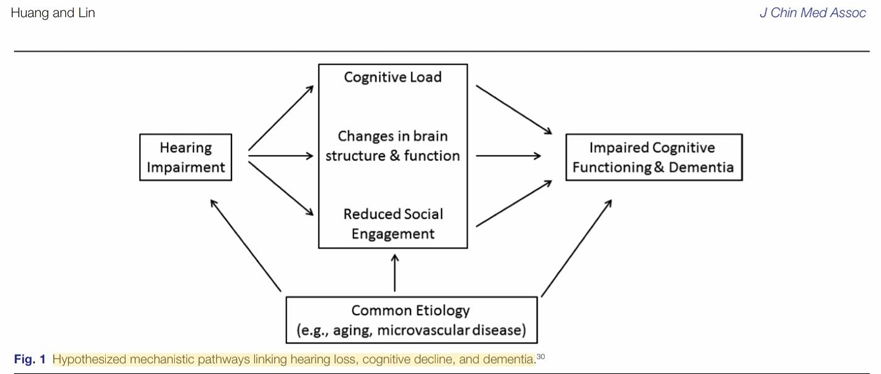
According to a recent study by world-leading researchers in linking hearing loss and dementia, Dr. Alison Huang and Dr. Frank Lin (2024) present a hypothesis on how hearing loss contributes to the gradual loss of mental functions like processing speed, thinking, and memory. Mainly, their three suggested reasons why hearing loss can contribute to the development of dementia include:
1. More Cognitive Load (or Mental Overload)
- When an individual experiences hearing loss, the sound signals received are poor, which will then trigger the brain to use more cognitive or mental resources to put more effort into understanding sounds. This leaves little mental energy left to process other mental functions like working memory.
2. Changes Brain Structure
- As seen in brain scans, severe hearing loss can physically change the brain. When a person cannot hear, the parts of the brain that are in charge of hearing become inactive. Similar to an unused muscle, the brain and its pathways begin to shrink and eventually die from a lack of auditory stimulation. Most importantly, these areas for hearing are also the ones responsible for speech, memory, and understanding.
3. Increased Social Isolation
- As previously mentioned, areas that are in charge of hearing are connected to other communication functions such as speech and understanding. Thus, hearing loss negatively impacts the quantity and quality of social interactions that individuals who experience the condition have on a daily basis. As Huang and Lin (2024) noted, social isolation can harm brain function because it may cause changes in behavior, stress, and body inflammation, all of which may lead to a decline in brain health.
While these mechanisms explain the direct link, hearing loss rarely operates in isolation. Instead, it frequently interacts with other common risk factors such as advancing age, chronic health conditions like diabetes and hypertension, and socioeconomic factors like educational attainment. Together, these factors could accelerate brain health decline which increases the overall risk of developing dementia.
Hearing Loss: A Modifiable Risk Factor of Dementia
Step Toward Raising Awareness & Making Hearing Care Accessible
References
Dar, C. (2026, March 18). Health expert warns of hearing loss among children - Philippine Information Agency. Philippine Information Agency. https://pia.gov.ph/news/health-expert-warns-of-hearing-loss-among-children/
Huang, A. R., & Lin, F. R. (2024). Hearing loss and dementia in older adults: A narrative review. Journal of the Chinese Medical Association: JCMA, 87(3), 252–258. https://doi.org/10.1097/JCMA.0000000000001042
Lin, F. R., Metter, E. J., O’Brien, R. J., Resnick, S. M., Zonderman, A. B., & Ferrucci, L. (2011). Hearing Loss and Incident Dementia. Archives of Neurology, 68(2). https://doi.org/10.1001/archneurol.2010.362
Lin, F. R., Pike, J. R., Albert, M. S., Arnold, M., Burgard, S., Chisolm, T., Couper, D., Deal, J. A., Goman, A. M., Glynn, N. W., Gmelin, T., Gravens-Mueller, L., Hayden, K. M., Huang, A. R., Knopman, D., Mitchell, C. M., Mosley, T., Pankow, J. S., Reed, N. S., & Sanchez, V. (2023). Hearing intervention versus health education control to reduce cognitive decline in older adults with hearing loss in the USA (ACHIEVE): a multicentre, randomised controlled trial. The Lancet, 402(10404). https://doi.org/10.1016/s0140-6736(23)01406-x
Montemayor, M. T. (2025, September 18). DOH: Around 1M Filipinos living with dementia. Philippine News Agency. https://www.pna.gov.ph/articles/1259030
Newall, J. P., Martinez, N., Swanepoel, D. W., & McMahon, C. M. (2020). A National Survey of Hearing Loss in the Philippines. Asia Pacific Journal of Public Health, 32(5), 235–241. https://doi.org/10.1177/1010539520937086
World Health Organization. (2025, March 31). Dementia. World Health Organization. https://www.who.int/news-room/fact-sheets/detail/dementia